Looking Away
01 February, 2026 - 7 min read
This piece was originally published in Are.na Annual vol. 7: Pool.
Are.na Channel: Neural Pools and Sensitivity
"You can see the stars better if you don't look right at them," I say. I'm sitting at the edge of an alpine lake on a backpacking trip with friends. We all go quiet as we practice seeing by not looking.
There's a counterintuitive technique in astronomy called "averted vision," where a star or other celestial body will appear brighter if you focus your gaze next to it instead of directly at it. For very dim objects, this method may be the only way to see them at all. We know now that averted vision works due to the structure of our retinas, but it has been in use long before it was formally named and the mechanism understood. Generations of sailors have used the technique to spot faint lights on distant ships and shorelines, though the earliest reference comes from Aristotle, who wrote of a slight tail on a star: "if you looked hard at it, the light used to become dim, but to a less intent glance it became brighter."1
Our group is backpacking at Marten Lake, which sits at the top of a short but steep ascent in the Cascade Mountains of Washington State. At this latitude the sun sets late in the summer and makes an extravagant retreat. Each evening we watch violent yellows, purples, and reds scatter across the sky, settling into a smoldering orange before being quenched by cobalt.
As the light fades, a handoff occurs in our retinas between the types of photoreceptors we use to see. Cone cells, gathered densely in the center of the eye, work best in bright daylight to provide high-resolution, color vision. These cells are our daily drivers that revel in the full spectrum of a sunset. When night descends, however, rod cells take over.

Rod cells are night vision specialists, more sensitive than cone cells and faster to adapt to low light. They fill the edges of our retinas and work together in groups to amplify scarce light signals. Our peripheral vision is built by these groups of rods, woven into a lattice of overlapping neural pools. Averted vision takes advantage of this specialized machinery. By shifting our gaze off-target and looking beyond what we want to see, we recruit these highly receptive bundles of cells and guide the faint starlight to land obliquely onto them. The outlying, rod-dominated areas of the retina are where the light is best detected, so only with an indirect glance do dim stars appear brightest.
While we lean heavily on this sea of rod cells to make sense of the dark, we may also notice the sacrifices they make for their specialization. Fine-grained visual detail is lost when rods pool their signals in larger groups, and greater light sensitivity comes at the cost of picking up most color wavelengths. Our resulting nighttime environment, seen through the same cells that amplify stars, becomes a fuzzy-edged wash of blues, greens, and greys.
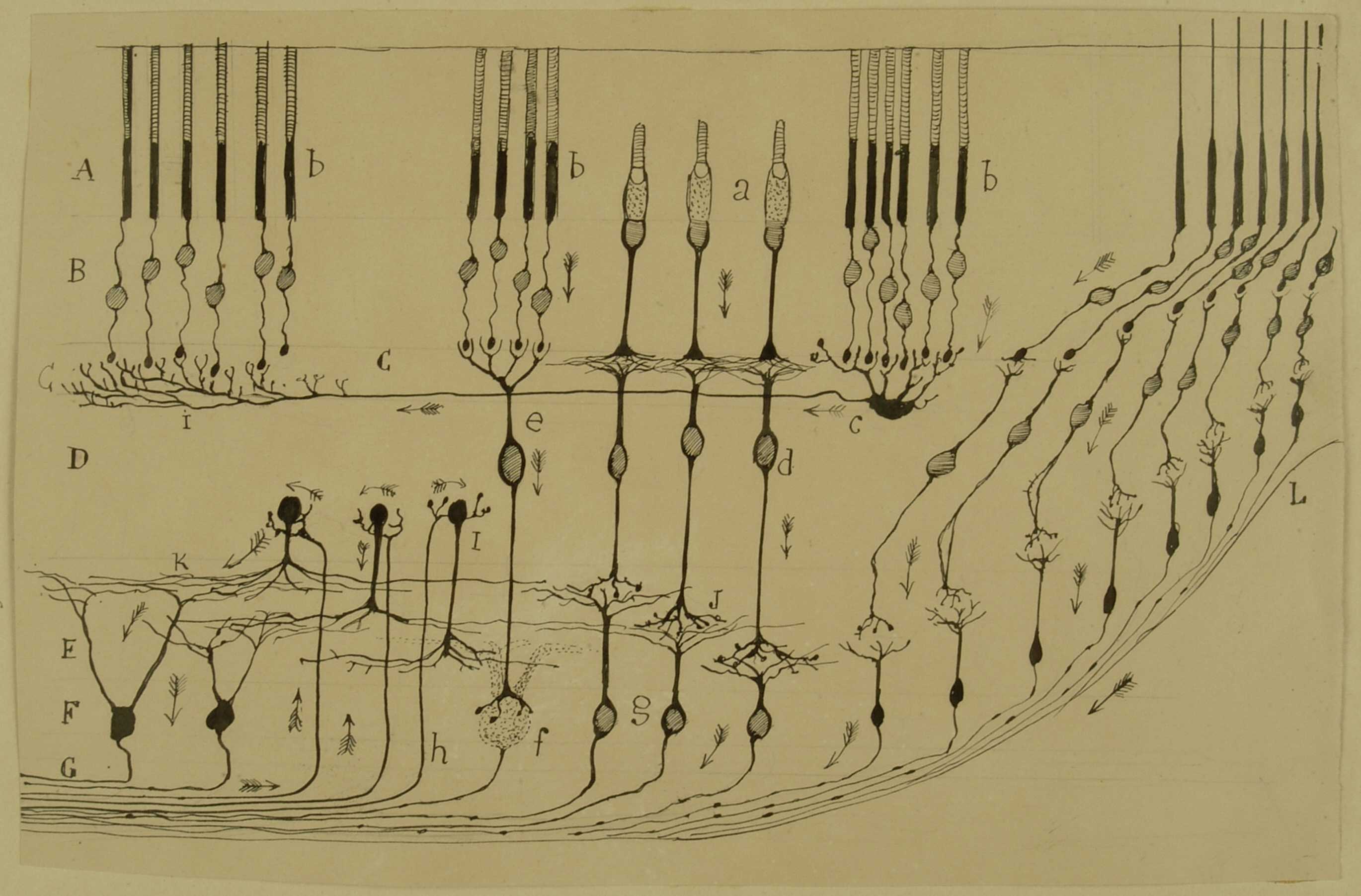
You can't speed up the process of dark adaptation, and as my friends and I sit by the lake, we don't try. We allow our photobleached cells to slowly recover from the light-saturated sunset. Stars populate the sky as our eyes adjust to detect them. Rocks on the opposite bank, having briefly disappeared into blackness, start to re-emerge as patchwork silhouettes.
I locate a very dim star in the sky and spend a few moments moving my focus on and off of it. The star pops in and out of existence as its light plays across my retina. In graduate school I trained as a neuroscientist, in part to understand how we are able to make sense of a complex world of sensation. I've found in this pursuit that learning more about the biophysics of an experience often increases my appreciation of it, my capacity for wonder not diminished by dry lists of cell types or neuroanatomical features. I know averted vision works by directing starlight onto the cells best equipped to detect the fragile signals, but despite understanding the mechanism, it still feels like magic that it works at all. There's a kind of transcendence I feel in recruiting the specific evolutionary features of my eyes to meet this light. By looking away from that star I open myself up to it, like an idea that comes unbidden to my mind long after trying to conjure it.
**
In 1975, the prolific musician and producer Brian Eno created a card deck called Oblique Strategies as a creative aid. Designed to be kept with him in the recording studio, the cards each offer a short instruction meant to nudge him out of creative ruts and see his work from new angles. Prompts in the deck include:
Discover the recipes you are using and abandon them
Make a sudden, destructive, unpredictable action; incorporate
Use fewer notes
Among instructions that range from highly abstract to explicitly musical, Eno also encourages distance from the work:
Take a break
Do the washing up
Shut the door and listen from outside
These are all kinds of averted vision. They exist in the deck to reorient ourselves to our work and invite in the unconscious progress that occurs when we do not attend to what we're creating. When we set a task down and allow our brain to hum along in the background. Who hasn't had a bolt of inspiration seemingly from the heavens, catching them unawares while engaged in something else entirely? Eno, along with the scores of artists who have used the card deck since its creation, recognized the value of an oblique approach and a less intent glance to see our work more clearly.
Despite how widely shared the benefits of breaks away from creative work seem to be, there's no single mechanism to turn to for explanation. Sleep consolidates memories and turns over the events of a day, allowing ideas to sift and settle into new shapes. Life continues to happen away from our work, bringing fresh encounters and influences. The breadth of Eno's suggestions in the deck is telling of how many different solutions may unlock the next creative step. Like the sailors spotting shorelines in the dark, looking away from our target may invite it to reveal itself, even if we can't explain why.
**
Night has fallen completely and the clear sky over the lake is an embarrassment of riches. I can't identify many individual stars without a guide, but I take guesses at how long the light has been traveling to reach me as I scan between stars. This bright one, a few hundred years. That small one, maybe a few thousand.
One of the furthest celestial bodies we can see without magnification is the Andromeda Galaxy, approximately 2.5 million light-years away. When a photon I now observe from that galaxy first embarked on its journey, our species did not yet exist. During the time it spent hurtling through the void of space, Homo sapiens emerged, spread across Earth, and turned our curiosity inward, developing the tools to interrogate how we perceive the world we inhabit. Gazing upward, I overflow with gratitude toward the projects of deep time that align in this moment: the lineage of humans creating new ways to explain ourselves to ourselves, and the universe inspiring those explanations.
I avert my eyes, ever so slightly, from the long-traveling photon. It alights off-center onto my retina. I look away in deference; I look away to embrace it completely.
- Aristotle (c. 350 B.C.E.). Meteorologica, Book I. Accessed from archive.org↩